
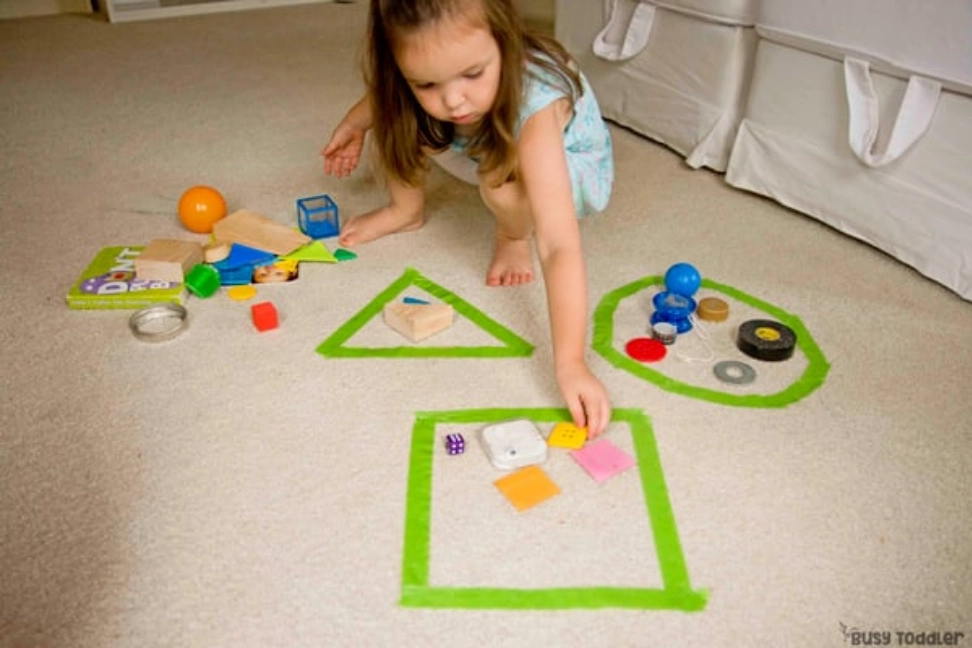
Make the rule visible
This activity asks learners to sort the same cards in two different ways. The goal is to explain the rule, not to guess what the teacher wants. Draw six large paper cards: a red circle, blue circle, red square, blue square, red triangle and blue triangle. Write the color name on each card as well, so the task does not rely on color perception alone. Use drawings instead of small loose objects when those would be unsuitable for the group.
Round one: sort by shape
Label three spaces circle, square and triangle. Ask learners to place each card and finish the sentence “These belong together because…”. The answer key is two circles together, two squares together and two triangles together, regardless of color. If a learner groups the red cards together, acknowledge the consistent rule they noticed, then return to the instruction for this round. The placement is wrong for the requested rule, not evidence that the learner cannot classify.
Round two: change the rule
Collect the same six cards. Label two spaces red and blue and ask learners to sort again. The red circle, square and triangle now belong together; the blue versions form the other group. Ask which cards changed neighbours and why. A useful explanation is “The rule changed from shape to color.” Avoid implying that the first grouping became false: both arrangements are valid under different instructions.
A transfer question
Add a card showing a green triangle, with the word green written on it. Under the shape rule, it belongs with the triangles. Under the red-or-blue rule, neither existing group fits; create a green group or explicitly set the card aside. This is the key discussion: a learner should not force an item into a category whose rule it does not satisfy. State whether new groups are allowed before the task.
A short observation sheet
Record three things: follows the current rule, explains one placement and notices when no group fits. Offer pointing or spoken explanations if writing would distract from the classification goal. Repeat with different drawings only when the observation shows a need. For older learners, apply the same structure to vocabulary or science examples, but define categories and check the answer key first. Translate labels and instructions into the teaching language while keeping the sorting logic unchanged.