
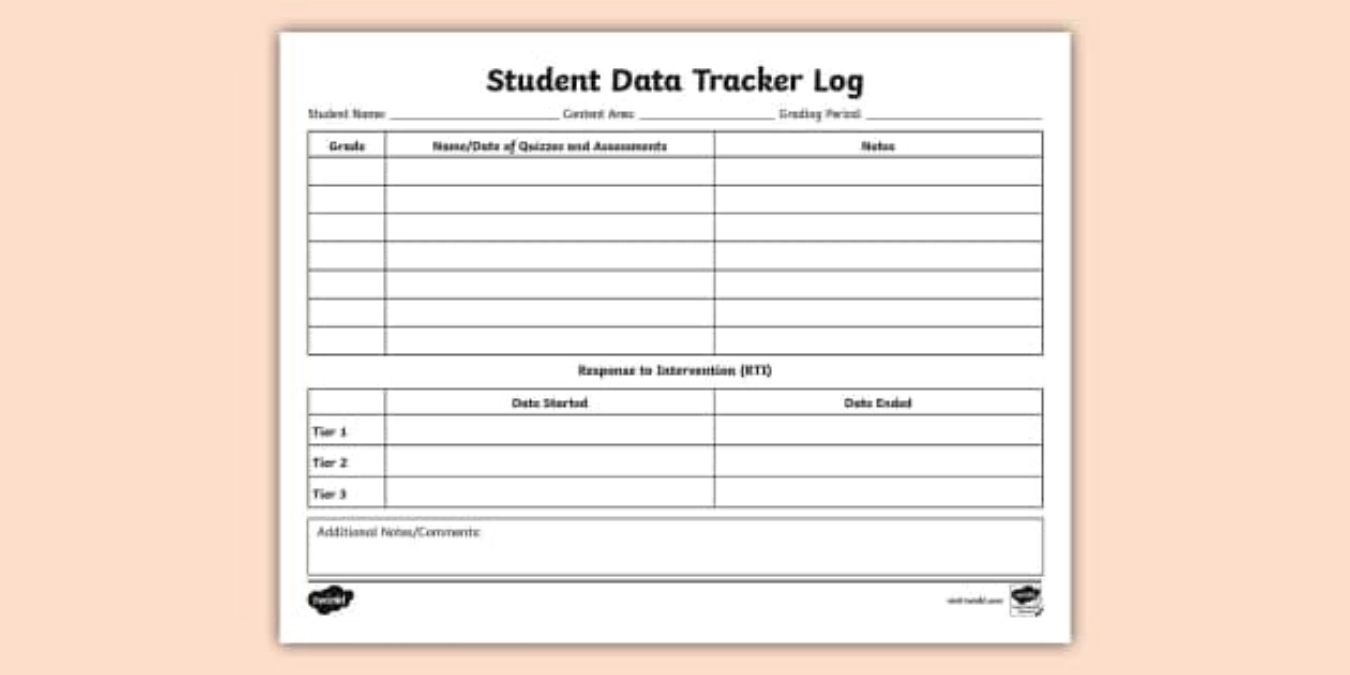
A student may know that a lesson is unclear without knowing how to start a question. A student question log turns “I understood nothing” into a specific description: where they stopped, what they tried and what needs explaining. It supports conversation with a teacher; completing a record must not become a condition for receiving help.
When to use the log
Use it after a short homework attempt, when reviewing a lesson or before a question session. If the instructions themselves are unclear, ask for clarification immediately. Students do not need to repeat exhausting attempts to prove that they deserve support.
Copyable table
| Section | What the student records |
|---|---|
| Task | Lesson and question number or paragraph |
| Stopping point | The step that is unclear |
| Attempt | What they tried or understood so far |
| Specific question | A short request for clarification |
| Explanation | The idea clarified by the teacher or approved reference |
| Next application | A similar question or an explanation in their own words |
| Status | Need explanation, trying after explanation, or need another question |
Leave the attempt section blank if the student does not know how to begin. Do not use the table to rank students or compare who asks most questions. Keep unnecessary family or health information out of the record.
Completed example
Task: a short reading paragraph. Stopping point: distinguishing the main idea from a detail. Attempt: the student chose a sentence describing a garden's colour because it attracted attention. Question: “How do I know whether this sentence summarizes the whole paragraph or describes one detail?”
Explanation after a fictional discussion: consider what the paragraph's sentences have in common, then check whether the suggested sentence covers the overall subject. Next application: identify a new paragraph's main idea and give a supporting sentence. Status: trying after explanation. Hearing an answer does not automatically change the status to “understood”; the next attempt helps reveal what is still unclear.
A short message to the teacher
“I am reviewing [lesson] and stopped at [step]. I understand [clear part], but I need help with [point]. Could you explain it with an example?” If writing is difficult, the student can ask aloud or point to the relevant part. The table is a support tool, not a communication barrier.
How teachers and families can follow up
Start by asking what the student means without calling the question easy or weak. Choose a small task that uses the explanation, and record another question if one emerges. A point that confuses several students may need a shared explanation while individual records remain private.
Review the log at an agreed time. Question count alone is not a measure of attainment, and needing clarification does not establish low ability. Keep the table on paper or in an appropriate learning tool. Explore Schoolizer for its available tools; this template does not assume a dedicated import feature.